Thursday, November 14, 2024

A Peaceful Day in Belhaven and Some New Friends


Belhaven – 6 kilometres walked

The plan was to stay in Belhaven for the day to sit out the approaching storm, then leave the following morning for either Oriental or Beaufort, subject to weather. So this was our day off!


After breakfast we went into town, got a roll of quarters from the local bank, then went to the laundromat, which looked to be a converted cottage, but was very clean and had great machines. Ana was shocked to discover we had forgotten the laundry soap, but a nice man there doing his laundry gave the rest of his bottle to us, which saved us a couple kilometers of walking.


We walked back to the commercial area we were at yesterday and went to the big thrift store to browse; Ana scoured through the clothing aisles while I focused on the cd selection. Now it could have been a real jackpot if I was more into Debbie Gibson, Conway Twitty, Julio Iglesias, Donny Osmond, and inspirational Christian music, but the only thing decent I could find was a Police/Sting anthology and a Bruno Mars album, then when I opened up the Bruno case it had a Lighthouse cd. Hard pass. I gave the checkout lady a quarter for the Sting cd and was pretty happy with that. Ana found a killer pink button-up shirt with dozens of flamingos that just screams, “I’m a Fashionista!”


We returned to the laundry, threw the clothes in the dryer and did some route planning and computer work while we waited. On the way out we noticed a bunch of local dudes milling around and the smell of fryer fat in the air and saw that another little cottage had been turned into a take-out place, and the guys there were workers grabbing a lunch to go. We were tempted to stop, but had our sights on Farm Boys, a burger and shake joint on the waterfront.

We walked back through downtown and stopped at an art gallery and cultural centre where we met the most lovely lady who gave us a full rundown of the town and filled in a few missing pieces for us. Before Hurricane Hazel in the 50’s, there seemed to be no memory of large storms hitting this town. After that one severely flooded the town the government implemented a program whereby they would raise your house above the flood zone in exchange for the home owner paying mandatory flood insurance for years after that, which is why we’ve noticed so many houses here built on pilings. We'd also noticed that high tide backs up many of the storm sewers, and some even had little fishies swimming around. Unfortunately her building, which she’d owned for three years and was at street level, had already been flooded six times since she’d owned it, once with 24 inches of water throughout. We also asked her about how the town supported all the fancy shops downtown when all the housing we’d seen seemed quite beaten up and the people we'd seen didn't appear to be particularly wealthy.


“Where have you walked to? That side of town?” she asked, pointing behind her.

“Yep, just there,” Ana said.


“Well, if you walk the other direction you will see a lot of nice housing, newer stuff, much larger homes. And this might sound awful, but in the early 1900’s this town was completely segregated – over there was the black area and on the other side was the white. And it’s never really changed, despite all the residents getting on together just fine, although the two groups tend to keep a friendly distance. It takes a long time for things to change.”


It was an illuminating conversation. It helps to explain why things are the way they are in the US, and how our issues in Canada are different, as we did not go through a Civil War nor have the same history with slavery. She also explained to us that Maryland was the dividing line between the North and the South, and we were now firmly in the South, which also explains the abrupt change in accents.


We grabbed burgers and milkshakes from Farm Boys and ate them outside beneath a canopy as the rain started to fall. They were delicious, just as good as the similar meal we had at the Shake Shack back in New York. Ana couldn’t even finish her milkshake and I was gutted when she had to throw the last quarter of it out. Sadly, I was too stuffed to finish it.


It was then over to Bad Moms Coffee for an afternoon chill-out with our books, cruising guides, laptop, great coffee, and atrocious Christmas music coming from the store speakers that was punishing to the customers and cruel to the staff. Sorry folks, Christmas music should start on Dec 24 and be completely yanked on Dec 26.

We loitered there until 4pm – opening time for the brew pub across the street, appropriately called ICW Brewing. Upon walking in we were faced with a row of 12 pour your own taps with little screens above them describing the beer in great detail. The owner gave us two glasses, one swipe card, and demonstrated the use of the taps. Tap the beer you want, hold the card up to the reader, start pouring and watch the screen as it logs the number of ounces and cost of the drink at fifty cents per ounce. That easy. As the owner and I were talking, and I was telling him we were on a boat, a guy at the bar came over and joined the conversation. Soon, we were knee deep in advanced boat talk and the owner retired to inspecting his tanks of beer.


Josh was from Colorado but had recently bought an Island Packet 38’ and spent the summer fixing her up and was now sailing her down to Florida. His friend Payton had joined him but would be flying back to Colorado in a few days and he would be solo the rest of the journey. Immaculate timing as our buddy boat Waddington was now at least three or four days behind us due to getting stuck with weather, so it seemed we had a opening for a new buddy boat for the next while and hey, there is always room for more. He is a very interesting dude and the three of us were having a great conversation so we asked him if he and Payton would like to join us on our boat for drinks and snacks. He said he’d have to check with her as the last time he’d found some new friends it hadn’t worked out too well. See, they were homeless heroin addicts he met under an interstate bridge somewhere in New Jersey as he was wandering around looking for a marine store. They seemed like nice people so he brought them back to the boat and it turns out they weren’t very nice at all. Who could have known? Anyway, he found a way out of the predicament. As they were rifling through the boat cupboards and stores, Josh and Payton surprised them with a blast of pepper-spray, then shot them in non-vital areas with a flare gun, then heaved them over the side. But as Good Samaritans they watched to make sure the wounded druggies were all able to swim safely to shore and take shelter under a new bridge. That’s just the sort of kind and generous people they are.


I picked Josh and Payton up in the dinghy and knew right away they were true sailors as they were wearing full sea-worthy rain gear and waterproof boots. The rain and wind had started so it was a wet and bouncy ride there and back but soon we were gathered in the cozy comfort of SeaLight’s cabin with a big bowl of guacamole, cheese, dips, crackers and lots of drinks to lubricate the conversation, and a fine conversation it was.

It wasn’t until after 10:30 that I dinghy’d them back in the worsening weather then I returned, secured the dinghy and boat and we called it a night, happy to have made some new friends.

Wednesday, November 13, 2024

American Accents and Camo Fashion in Belhaven, NC


Alligator River to Belhaven– 50 nautical miles sailed, 3 bridges

Strangely, my beautiful wife was awake with me at 5am as the strong winds continued to thrash our boat as they had been all night. She is a creature of the night so my early to rise and early to bed routine really doesn’t work for her. Maybe it’s a good thing as she gets plenty of alone time at night to communicate with the kids, watch tv, read, research stuff (which I’ve heard leads to mindless doomscrolling), review her fashion inventory, and she’s even been known to clean closets into the early morning hours as I sleep soundly. Me, on the other hand, I’m regularly up hours before her leading my own private life which includes writing, banking, administration, research on boat stuff, but primarily writing, which can resemble doomscrolling when I’m really into it.


What Ana was working on was a plan for tomorrow and Friday as there was a big storm coming and we didn’t want to get caught with nowhere to hide. She researched all the available options and put in a booking reservation through Dockwa, an online platform for marina slips, for Thursday and Friday nights at Belhaven Marina. We’d have to wait for the marina to confirm the reservation, but at least we had a plan.


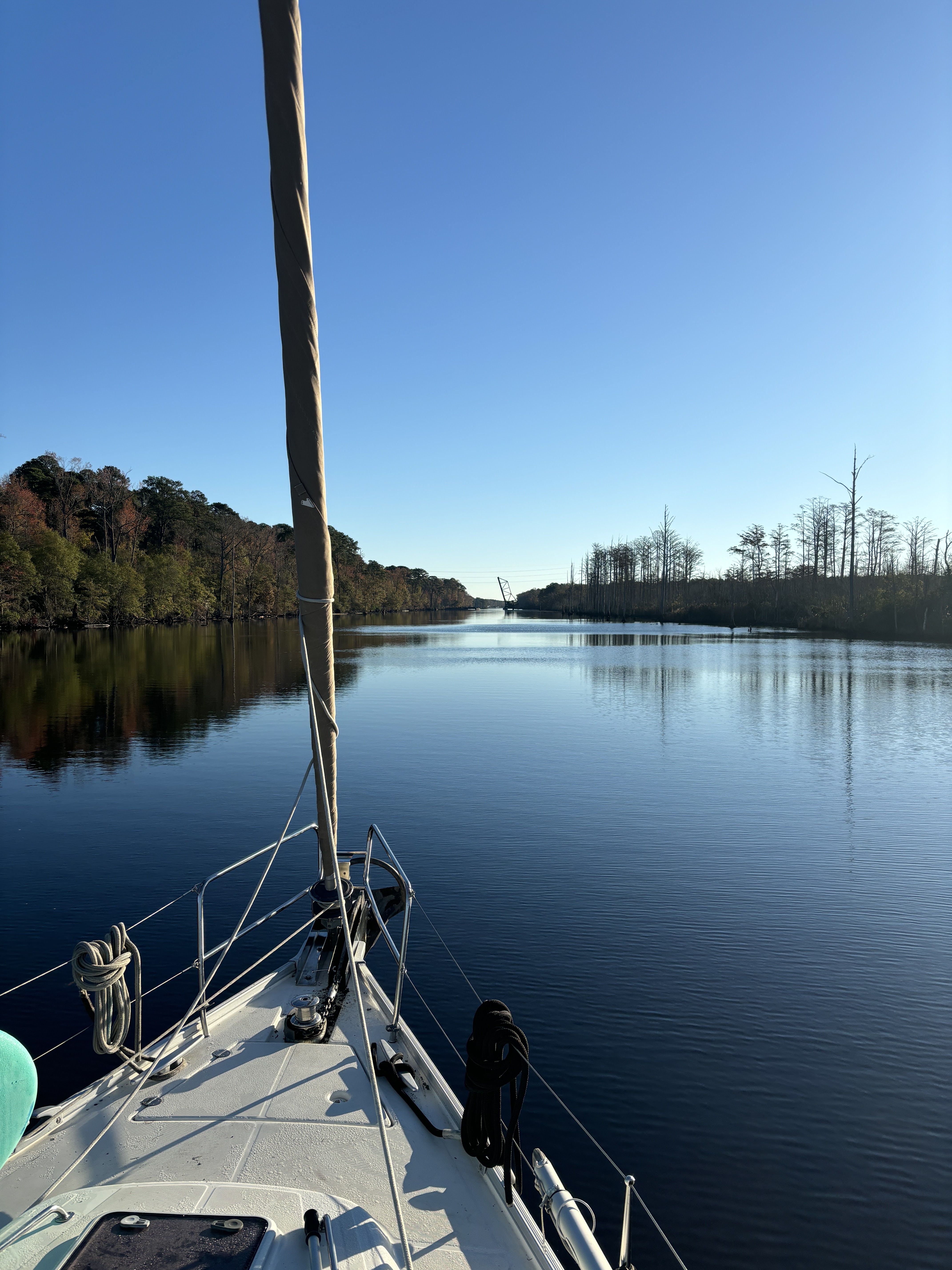
As soon as it was light we pulled anchor and got underway dodging crab pots again as we started south down the Alligator River. A massive 2.5 mile long bridge spans the river and we lucked out with the operator as he held the swing bridge open for us to pass behind several vessels that were a few minutes ahead of us. That was really the only excitement for the day as we navigated the rest of the river with our headsail up and 20 knot north winds pushing us along, then followed the ICW through a 23 mile long narrow canal, passed through a couple of larger bays, then found ourselves at the town of Belhaven by 2:30 with a fine spot in the sizeable and decently protected anchorage.


We gathered up our garbage, grabbed our shopping roller cart (which our friend Kate affectionately calls “the mini van”) and took the dinghy into the town dock. There was one main street in downtown with a series of interesting shops - a serious looking steak house, gourmet coffee shop, clothing stores, and two places that looked to be large event spaces, with fancy tables and chairs, but nobody inside. Ana ordered a latte to go at the coffee shop and then browsed the fashions at the attached clothing store while I sat on the spongy green couch and read a North Carolina tourism magazine. This is one state I really know nothing about. Not a single thing comes to mind when I think about North Carolina. Even after browsing the magazine I’m still not sure what this state is about. But we have noticed one thing here. The accent. It’s changed.

The US has a far broader range of accents than Canada and probably the rest of our Commonwealth brothers and sisters. Until recently, the accents of the people we’ve met have been similar. You can sense a little American twang in them, but they are not that different. As Ana and I were walking through Belhaven towards the commercial area, a lady in an oncoming car slowed down, lowered her window and said, “Y’all need a raaaaahd?” We politely declined, explaining we were enjoying the walk, but her accent was wild. Same as the lady working in the marine store we stopped into, real Southern-like, and super friendly. We also stopped at the Dollar General and found deals on cheese and snacks, and the two cashiers were rocking it hard in the local dialect.


Another observation here. Most of the men we’ve seen are wearing camo, and one was carrying a rifle in a case. Now they didn’t have that brown and black grease paint on their faces and weren’t doing the prone army crawl, dragging themselves around by their forearms and elbows, but they did all look to be on their way to shoot animals in the face. In the marine store I noticed a Yamaha outboard engine that had a brown cowling (cover). I mentioned to the nice lady that I’d never seen a brown outboard before.


“It’s for hunners,” she said, smiling.


“Hunners?” I said.


“Shore, duck hunners and the laaahk. Birds cain’t see em.”


As we walked the highway towards the Food Lion grocery store we noticed little wads of cotton stuck to the grass and blowing around on the road.


“Must have been a couch explosion here somewhere,” I surmised.


“Maybe a road rage incident, but they used pillows instead of Glocks to sort it out,” Ana guessed.


“You’d almost think there was a cotton field around here,” I laughed. Then we both looked up…and saw a cotton field.


Neither of us had ever seen one before. And it was beautiful. Millions of fluffy white cotton balls balanced atop black stems. It was artful, and a delight to see. We walked right into the field and I plucked a cotton ball. It was so lovely, I felt like sticking some in my ears. I pocketed my new treasure and we continued onto the grocery store, where we picked up a few things, then walked back through the darkness with our full buggy, enjoying the quiet and still evening vibe of Belhaven.

Tuesday, November 12, 2024

A Long Day With High Winds


Chesapeake to Alligator River – 62 nautical miles sailed, 5 bridges

After a quick morning boat-to-boat tete-a-tete with Mike, we decided to push off at 8 am to make the first bridge opening which was about three miles away. The ICW felt very much like the Erie Canal, with decapitated rotten trees protruding up from the shallows, branches floating in the channel, wide sections that narrowed, then widened again, and a variety of landscapes from full forest to grassy marsh. There was a small craft warning today as the winds built to a sustained 20 knots gusting to 30, which was okay in the channels, but we had to travel through two very large and exposed bays – the North Landing River and Albermarle Sound, but fortunately the wind was behind us so we flew the headsail, making 8 knots at times, and the boat handled the chop well.


Mike and Carla sailed behind us and must have thought we were a couple of dopey amateurs as I first forgot to turn our VHF radio on in the morning (which is why I have a pre-departure checklist…which I didn’t bother to look at today) and only realized it when Mike was yelling at me as we waited at the bridge because the bridgemaster was trying to call us. Then again, when traveling through a very narrow and long channel in the North Landing River I had the boat on autopilot and Ana and I got so busy route planning that I forgot to monitor it, and when I did we were in the shallows with an inch of water below the keel. I cranked the wheel to the right, abruptly turning the boat back towards the deeper water as Mike and Carla no doubt looked upon us aghast. You could say I had a bad morning, and that’s the thing with this sort of traveling – you need to be paying attention ALL THE TIME because when you don’t, or when you take shortcuts, things can go wrong very quickly.


Mike and Carla dropped off at Coinjock marina, which looked like a lovely place, but we wanted to make more miles for the day so kept on going. Once we reached our planned anchorage tucked behind Buck Island we found the island was no more than a grassy marsh so offered little protection from the wind, so we decided to keep on going and made it to an anchorage in Alligator River. But we didn’t arrive in the inlet until sunset and for the last 45 minutes, Ana had to be at the bow in the rapidly darkening sky and 25 knot winds to spot crab pots for me so I could dodge them. We finally dropped the anchor in ten feet of water, got it set, then hunkered down in the cabin as the wind screeched, the mast creaked, shackles banged, ropes slapped, boat bounced, waves pounded, fittings squeaked, and fibreglass flexed.

Surprisingly, we had an amazing sleep. And I think 62 miles covered in a single day is the highest yet for this trip.

Monday, November 11, 2024

We Learned Two Big Lessons Today


Norfolk to Chesapeake – 14 nautical miles sailed, 8 bridges, 1 lock, 5 kilometers walked

We learned (re-learned) two big lessons today. First, if you are relying on limited space at a free dock at the end of your day’s journey, leave early. Second, if you need help, ask for it.


I was up at 4:30 working fruitlessly on consolidating our boat tracks onto a Google map so people can see exactly where we’re at. Our charting software Aqua Maps records our boat’s movements in a series of .gpx files and I’ve been trying to get these loaded onto a map but keep running into issues – file size, too many files, format incompatibility. I gave it one last heroic effort today but eventually gave up as it just wasn’t working out. I’ll figure it out.


Even after last night’s route planning, we still weren’t entirely sure what our next leg would be, but after more online research we decided to leave by 1pm to get through a few bridges with scheduled openings plus a lock – one of the very few on the ICW. It became clear that our original plan to cover 42 miles one the first day of the ICW was not going to be possible.


We left early on the dinghy back into Norfolk and found ourselves at low tide with a whole lot of mussels and mollusks stuck to the pilings and ladder we used yesterday. In an ingenious move, I decided to run my middle finger along the edge of a mussel to do a sharpness test. Well, it was sharp, and it carved a nice slice into my finger. We used a series of small fenders and multiple ropes to get the dinghy positioned such that it wouldn’t get sliced to pieces, then we started walking. We wandered down Freemason street which is lined with houses that tell the story of architecture in this part of the country for the past couple hundred years and Ana took some great photos – she has an amazing eye for shots and any great pictures you see on these journals were probably thieved from her phone.


We had hoped to pick up a couple things at a grocery store, but it was a 45 minute walk so we weren’t sure we wanted to spend our limited time trotting down expressways. Fortunately, we found a small general store downtown and picked up what we needed, although we passed on the twelve-dollar sourdough loaves.


In the spirit of Yin and Yang, unity of opposites, and the philosophy of duality, I have learned that I need to balance my lifelong dream of sailing to the Caribbean with a few nightmarish moments, so I accompanied Ana to the mall. Ass, meet bench. Bench, here comes my ass. I did have a nice chat with an ex-New Yorker working at a kiosk selling perfumed powders. There was basically nobody in the mall besides us so I guess he was looking for company. I also browsed through a student art gallery and took a photo of one interesting piece. Ana bought a pair of fancy shoes for five bucks, so I now had to decide which of my shoes I was going to have to jettison to make room for those beauties.

We were hoping to visit the Nautica and warship exhibit but found out it was closed on Mondays, but we wouldn’t have had sufficient time with our altered plan so we’ll have to catch that one on the way back up.


We returned to the boat, Ana made us a delightful pancake lunch, then we were off, ready to face bridge number one for our first leg of the ICW. Well, the first bridge was a railway bridge that is usually open, but was closed for a train. We waited for a full hour, circling in the bay between a massive container ship on one side and a humongous aircraft carrier on the other with a Navy patrol boat with bow mounted machine gun patrolling around. A train finally appeared, then stopped and went backwards, then forwards, then backwards again, taunting us mercilessly. The train finally cleared the bridge and it began lifting at an altogether glacial pace, but it finally rose enough for us to get through. As we passed beneath the giant guillotine, I noticed a huge log floating in the water to our side that had two big steel spikes protruding from it. I kept my eyes on the water.

The next bit of anxiety came when we had to pass under the first fixed, low bridge. The minimum height of fixed bridges on the ICW is set at 65 feet, and the top of our mast and various attached gadgets comes in at about 61.5 feet. But we’ve read online that tides and winds can impact water levels so you don’t always get your full 65 feet. We both looked up nervously as we passed gingerly beneath the bridge, but fortunately there was several feet of clearance and we breathed signs of relief. There are going to be dozens or hundreds of more like this, but it’s good to get the first one over with.


We arrived at the lock with a thin film of anxiety after remembering the challenging locks in the Erie Canal. We had to wait a while for a huge barge and tugboat to exit, then us and three other boats entered and got tied up. Strangely, after the gates closed and the water started to drop, it only went down about eight inches…then the forward doors started to open and the lockmaster said we were good to go. Whew. The other difference here is that boaters had plastered the rubber bumpers in the lock with their own personalized boat stickers. How did we forget to get SeaLight stickers made??

After the lock there were two free public docks for transiting boaters plus a small marina. The first dock was full, then after clearing a lift bridge we were disappointed to see the second dock was full too, and it sure didn’t look to be 400 feet long as advertised in our cruising guide. We glided over to the marina as there was space available near their fuel dock but a worker there shoo’d us away. We didn’t know what to do as there were no more anchorages here and a few miles down the ICW was a swing bridge that would not be opening until after dark, and we didn’t want to be on the ICW in the dark. We thought about asking one of the sailboats at the dock if we could raft with them, but we chickened out and instead kept going in the hopes of finding a place to anchor. Lesson One for the day – don’t be the last to arrive at a free dock or popular anchorage.


We continued for a mile or two and had no choice but to anchor in shallower water just off the channel. We decided to set two anchors to keep us parallel to the boat traffic. I wrestled our rusty secondary anchor out of the anchor hold and a couple hundred feet of rope and tossed it off the stern. But no matter what we tried, we could not get it to set. It dragged and dragged and dragged. I retrieved it, then dropped it into the dinghy in the hopes I could wind it up on a tree or log or something closer to shore. As I was doing that I noticed the anchor didn’t look quite right so I turned it over and found that a bolt had broken loose and it wasn’t ever going to set properly. I motored the dinghy into the shallows while Ana held onto the other end of the rope as the boat swung, then the dinghy engine prop hit a log and died. As we performed this zany anchoring routine, a man sped up to me in a boat and said we couldn’t anchor here…unless we wanted our boat demolished by one of the barges full of steel pipe that regularly transit the ICW overnight and take up the entire channel. So we gathered up the anchors and decided we’d need to go and beg for one of the other boats to let us raft. Lesson Two for the day – ask for help when you need it, not after wasting a bunch of time and making bad decisions.

In the end, everything worked out. Mike and Carla in their 46 Hunter “Let’s Sea” were happy to let us raft alongside them, and invited us on board for drinks with another couple they had just met – John and Catherine on their Hanse 40 “Adventure”. Shortly after we got settled, another sailboat arrived in the dark looking for a space and John and Catherine offered up their boat so we helped them get tied up alongside it. They were Tom and Danielle on their Beneteau 41 “Hygge” with two kiddies and a dog. I had a quick chat with them then we returned to the Let’s Sea cockpit for some more great conversation before pulling the plug on the evening around 9:30.


We made some new friends, had a secure spot for the night, and put the wraps on a most interesting day.

Sunday, November 10, 2024

Norfolk, Portsmouth, and a Navy Extravaganza


Langley Air Force Base to Hospital Point at Norfolk – 21 nautical miles sailed, 6 kilometers walked

We left Langley at first light and were soon back on the wider Chesapeake on our final run for neighbouring cities of Plymouth and Norfolk. From 15 miles out, the area had the strangest skyline – it looked like a mess of pick-up sticks. But as we neared, what came into focus was a massive industrial corridor of cranes and huge loading/unloading machinery to support all the container ships and freighters we’ve seen up and down the lake. More impressively, this area is home to the largest naval base in the world – the Naval Station Norfolk –with the highest concentration of Navy forces in the US. The massive piers and dockage facilities were populated by an array of Navy ships – we identified several gargantuan aircraft carriers but also other ships with guns, communications equipment, loading equipment…really, it was very hard to know what these ships were used for or identify much of the equipment on them, but it was simply amazing being so close to this concentration of military hardware. Mixed in with all the piers were many other industrial facilities like fuel depots, processing plants, tugs and barges, shipbuilders, giant dredgers, and the like. It reminded me much of the Rust Belt cities along Lake Erie and the Detroit River, just to a much larger, mind-numbing scale.


We arrived at the Hospital Point anchorage by 10:30, which is Mile 0 of the ICW, and filled up with diesel and water at the nearby Tidewater marina then got the hook set and dinghy’d back in the marina to explore Portsmouth. In truth, there wasn’t much there to see and neither was there anything open on a Sunday besides a few bars and restaurants…and a bunch of churches. So we got back in the dinghy and tried our luck on the other side of the river. Bingo!

After tying up at one of the many free public docks, we found ourselves in the Pagoda & Oriental Garden, whose centrepiece was an original pagoda given to Norfolk as a gift from the citizens of Taiwan in the late 80’s. There were also fountains, gardens, and a coi pond full of colourful, tame fish, just in case your striper fishing in the river didn’t work out. Best thing is the pagoda was built on a foundation of concrete pillars that used to hold a giant molasses storage tank. You just don’t see as many molasses storage tanks around as you used to. I wonder where they put the stuff now?


We did a walk around town to get our bearings and found a compact, attractive city centre with some amazing architecture and a beautiful waterfront. There wasn’t a lot open, but we did find a small arcade with some very unique shops – a custom leather maker who fabricated belts while you waited, a soil store selling specialty dirt and plants, jewelry shops, and some other knick-knackery places Ana went into while I sat on a nice bench. On the riverfront was the Waterside Festival Marketplace with bars, restaurants, and a cool outdoor performance space. From there, we walked the waterfront trail which passed a marina with one of the most beautiful boats we’ve ever seen, then we continued past the giant Nauticus facility which is a science and technology museum, but also has the USS Wisconsin – one of the largest battleships ever built by the US Navy. We didn’t have enough time to visit, but we got great views of the ships from the public walkways.


By sunset we were back on the boat and had a drink in the cockpit, a chat with Kate and Ben who were still in Deltaville and likely now stuck there for a few days with strong winds forecasted, then had a nice dinner and capped off the day with some route planning.

Saturday, November 9, 2024

How Anchoring Works


Deltaville to Langley Air Force Base – 35 nautical miles sailed

By the early morning the wind was howling from the north at 20 knots, driving our boat to the taught end of the anchor scope and putting us into 6 feet of water which is exactly the depth of our rudder, putting it in jeopardy. After repositioning and resetting the anchor we held tight for several hours then at 11:30 set off in the midst of a small craft advisory to make some miles for the day and take advantage of the strong north wind pushing us southwards. The first couple of hours were rough and rolly polly as we were taking the three to four foot waves broadside as we traveled south-east to get into the open bay and away from the shoals closer to shore. After turning south it was an easy ride, especially when the winds weakened a bit in the afternoon, and yet we saw 13 large freighters anchored in the bay, not moving, perhaps waiting out the waves. We arrived in Back River and anchored in the middle of a huge, shallow bay, just off the Langley Air Force Base (which explains all the fighter jets we’ve seen flying around).


Today I want to write about anchoring. We have been learning a lot about anchoring and will be learning even more in the coming months as our default plan is to anchor out every night unless we can find free dockage, reasonably priced mooring balls, or have to dock at a marina for whatever reason.


Anchoring a boat works like this. You start with a length of chain or rope (or sometimes a combination of both) and the entire line is called a rode. One end of the rode attaches to the boat, usually in the anchor locker which is at the bow of the boat. The other end attaches to an anchor, which usually sits in an anchor roller on the bow which allows it to easily drop down or be hauled up, but it can also be stored in the anchor locker. The anchor can either be dropped into the water manually by hand or some boats have an automated system called a windlass, which is an electric (or sometimes manual) winch with a drum that the rope or chain winds around and is driven by a chain wheel with grooves or teeth that grasp onto the rope or chain. The windlass is usually operated by push buttons at the bow of the boat, or an attached controller, or a wireless or push button unit at the helm of the boat where the steering wheel and throttle controls are.


The anchor itself comes in many shapes, styles and weights. You normally match the weight of the anchor to the length and weight of your boat. Heavier is better as it will provide more holding power. Anchor style is as important, or maybe even more important, than overall weight. Styles include the Plow, Bruce, Danforth, Rocna, CDQ, Mushroom, Claw, Grapnel, Delta, Kedge, and dozens of other types that have been used throughout the millennia of sailing. The best style of anchor really depends on the type of bottom you are securing too, which could be sand, clay, mud, rock, pebbles, shale, weeds, or sea grass. This is why most boats will carry one primary anchor and one or more secondary anchors of different types. SeaLight has a 25 kilogram Rocna anchor as its primary and a similar sized Danforth as a secondary.

Here's the next step in anchoring. You find a spot where you will be able to swing a 360 degree arc around the anchor without floating into shallow water or obstructions. This can be tricky in a small anchorage or one with boats already anchored. Next, you drive your boat into the wind or current then let it come to a halt and drop the anchor. You then put your boat into reverse and move backwards, away from the anchor, as you spool out your rode. As for how much rode to let out, it depends on several factors. First is anchor scope. This is the ratio of the length of an anchor line to the depth of the water, and the minimum recommended is 5 to 1, but it’s better to get to 7 to 1 if you can. This means that if you are anchoring in ten feet of water, and your bow sits five feet above the water line, you need a minimum of 15 feet drop * 5 factor = 60 feet of rode, but better to have 15 * 7 = 105 feet if there is sufficient swinging room. Boats with just rope for anchor line will usually choose for more scope, but ones with all chain may use less as the chain itself is heavy and provides downward force which helps to keep the anchor in place. This is why there are only certain locations which are good for anchoring. It can’t be too deep – for example if you are anchoring in 30 feet of water you could need 245 feet of rode, which is more than most boats would carry. You want to find a spot that has between say 7 and 15 feet of depth and a bottom type that suits your anchor style.


Back to the anchoring process. You’ve now dropped anchor and need to reverse as the rode plays out, and you continue until the you reach the end of the rode, it tightens, and the anchor begins to set itself into the bottom. Our Rocna is designed to burrow itself into the ground, and to do this you want to continue pulling on the anchor with the boat in reverse until it is well set. With a questionable bottom we sometimes put the motor in full reverse and pull for 30 to 60 seconds until we know the boat is not moving and the anchor is full set. The final step is to tie off the rode to the boat. Some boats with a rope for anchor line use a bow cleat. Others, like us, insert a pin into the steel anchor roller and through the chain to secure it. At that point the anchoring is complete.


Now what happens when the wind shifts or the tidal current shifts and moves the boat in the opposite direction of where you originally set the anchor. Well, in some cases the anchor may be dug in so deep it will hold the boat even when pulling from the other direction. But usally the anchor will pull loose then reset itself in the new direction the boat is now pulling from. This doesn’t always work so well, for example if the anchor pulls free and the bottom in the other direction is rocky or full of grass. In this case, your boat starts to slip and, if you are on the boat, you will need to pull up the anchor and reset it in the new direction, possibly in a different location. If you are not on your boat, then you might arrive back to find it gone, or in a slightly different location if it eventually sticks. We have an app we use called Aqua Maps which allows me to set an anchor alarm on my phone and stream it to Ana’s phone, so when we leave the boat we can still montor it. If the boat moves outside of a pre-set radius, then we drop our calzones or sushi or hot dogs or whatever we happen to be eating for lunch and sprint back to the dinghy so we can rescue our boat before it crashes into something or floats off into the Atlantic, destined to become a ghost ship.


There are some situations where you may set two anchors, for example in a very tight anchorage where you are the only boat and don’t want to swing. In this case you could set your primary anchor off the bow and a secondary anchor off the stern to hold you in place. We did exactly this back in Saugerties, New York, and it worked fine until the morning when a huge wind blew in and dislodged our stern Danforth anchor because I didn’t have enough rode out. That created some morning chaos. Another method is something called a Bahamian Moor where you are faced with a tight anchoring space and a tidal current going one way that will reverse and go the other way on the next tide shift. In this case you set your primary anchor the way you normally would, but let out twice as much rode as required. Then, drop a second anchor and let out that rode as you retrieve half the rode from your first anchor. This then gives you two anchors, one for each current, and the boat will basically stay in place.


That’s the story of anchoring. Actually, that's just my story on anchoring. I am no expert and there are entire books written on the practice. We’ve been getting better at it, but we still have a lot to learn, with daily opportunities to do so in the coming weeks and months.

Friday, November 8, 2024

Deltaville, a Scary Dog, and Observations on the US Military


Solomons Island to Deltaville – 55 nautical miles sailed, 1 mile by dinghy, 3 kilometres walked

In the country with the largest fighting force in the world you are sure to see signs of the miliary everywhere. And we do. From the fighter jets in the sky, to Navy boats on the water, to the people in uniform and Army vehicles we see on the streets, and the military dedications, monuments, and cemeteries we see everywhere we go, it is inescapable. In a town we were recently in we passed by a regular cemetery then right beside it was a military one, with identical white markers lined up in perfect rows as if preparing for a march. There were far more grave sites in the military one than the regular one and we wondered if all these dead soldiers were from the local area. It’s great to have the biggest army and get involved in many of the global conflicts, but there is clearly a price to pay. We will see what happens in the coming years, but it is undeniable that the US wields the world’s mightiest fist and they invest a great deal of their wealth to maintain this.


One does have to stop and realize that the United States can do whatever it wants because there is no other country with a military large enough to stop them. Unless, maybe, if it was the US against the world, but that’s an unthinkable proposition. In any case, Canada would not fare well with our pathetically underfunded military, weak-kneed politicians, and blind faith that our neighbour will always protect us from foes, and could never, ever turn on us. I have been thinking about this a lot the last couple of days in the wake of the recent election in the US and some of the extreme ideas that have been put forth by the incoming party. We plan to be traveling back through the US sometime between March and May. What will the situation be? Maybe they will close their borders to all foreigners. Maybe they will ban non-commercial foreign marine traffic. It seems to me that everything is on the table with a government willing to go to extremes. In any case, there is nothing we can do about it so we will just continue along our way and hope for the best. We do live in interesting times.


Today we were looking for a spot about 60 miles south to anchor for the night before making the final push to Norfolk, which is Mile 0 for the Intracoastal Waterway (ICW). We pulled into Deltaville around 2:30 which gave us a few hours of daylight to explore. Ana had to do some work for our yacht club so I put on my shorts and went for a swim. Incredibly, this is the first time I have been in the water on this trip. I put on a mask and inspected the undersides of the boat. Surprisingly, there was no growth of anything on the hull. And the sacrificial zinc anode (which protects the metal components of the boat from electrical corrosion) looked the same as when I put it on back in the spring. These two discoveries were of immense relief to me as I just didn’t know what to expect with the boat now in ocean water. I had myself a quick ocean bath, rinsed off with fresh water, and felt fresh as a daisy as my mom likes to say, although I have no idea why daisies would be fresher than any other flower, say a tulip or rose.


We took the dinghy into the public dock, which was a heavily built wooden structure, rigid, unlike many of the floating docks we’ve been using which move up and down with the tides. Well, this one was a pretty high jump from the dinghy. I was able to get up there with my longer legs but Ana had to take a few moment to figure out her strategy. She stood on the edge of the dinghy and reached up to me, but then the dinghy started slipping under the dock taking her with it. Soon, there was just a head and arm sticking out so she abandoned that plan and fell back down into the dinghy. Her second attempt was fully successful, even graceful. We walked through a quiet neighbourhood enjoying the warm temperature and soon came to the main commercial street. I found a dumpster to toss a bag of garbage we brought from the boat (living on a boat makes you realize how much garbage you generate, especially in the US with the obscene amount of product packaging used for everything) then we walked up the main street, but everything was closed except for the public library and the True Value hardware store. We went into the hardware store and found a nice little broom to replace the one that had broken a few days before. If Ana can’t sweep the cockpit floor at least six times per day she just doesn’t feel right, and that takes a toll on the cleaning instruments.


The library had their annual book sale and, though it was done for the day, the librarian opened the vault for us and we found a treasure trove of titles, each available for the reasonable price of one dollar. I already have about five books on the go so I didn’t get anything but Ana picked up a novel.

During the walk back to the dock we were approached by what looked like a horror movie creature. Something black with black eyes walked towards us slowly and painfully. It was skinny, with legs that seemed multi-jointed, bending the wrong way, mantis-like. I got the broom handle ready to beat it when it attacked. But it was just a dog, a very old and sick dog, with today’s steps likely its last. It expressed a morsel of interest in us, but we steered clear, and looked back to see it slowly wobble across the road and up a driveway. 


We were finished dinner and cleaned up by 6:30, leaving the prospect of hours of darkness. We’ve been experimenting with evening entertainment. We have a television in the main salon, but it has a flaky HDMI connection and can’t consistently connect to our Mac. There is a second newer television in the portside aft cabin and we horsed around with that stupid thing for hours the other day trying to get it to connect through AirPlay, and when it finally did, for some reason it put the movie on triple speed. If it were a Chinese kung fu movie it would have been fine, but it just didn’t work for our selection. We’ve tried watching the laptop in bed but I can’t stay awake for longer than 15 minutes and I do not really want to be up at 3 in the morning typing obscenely long journals. So we tried converting the table in the main salon into a bed and using cushions and blankets to make a comfortable seating area. It worked okay. I was able to stay awake for a full horror movie then part of an episode of a series we’re watching.

By 9pm I was out.